




 Complete list of scholarships at foreign universities for 2026


Service payment
Fill out the form and continue to payment via Stripe


Cambridge is a collegiate university: faculties are responsible for the curriculum and exams, while colleges are responsible for accommodation, tutor support, and some of the small‑group classes (supervisions).
International students make up a significant part of the university — about 25 % of bachelor’s students, i.e., around 3,200 people from more than 90 countries. The university’s official position is that there is no priority for those paying the international rate — selection is based strictly on academic achievements and potential.
The competition among international applicants is particularly high: the university explicitly calls it “fierce” on the official page for international students.
Cambridge tests a candidate in several dimensions at once: academic grades, the depth of knowledge of the subject beyond the school curriculum, the results of specialized entrance tests where they are provided, and the ability to think independently in an interview. It is not enough to meet one criterion — the university is looking for a match for all of them at once.
When applying to Cambridge, an applicant chooses not only a programme (course) but also a college — there are only a few dozen of them, and each is a separate organisation with its own dormitory, dining hall, library, and tutorial support system. The college is responsible for the day‑to‑day student life and part of the education in the form of supervisions — classes in very small groups, sometimes one‑on‑one with a teacher.
The curriculum and final exams are the same for all students of a particular course, regardless of the college. You can specify a particular college in your application or submit an open application — in which case the university will assign the college itself.
Admission requirements for the same program may vary slightly between colleges, so it’s best to check this information separately.
There is no single list of grades for everyone: the requirements depend on the specific program, the country where you studied, and the type of qualification. The university accepts A-level, International Baccalaureate, 5 or more Advanced Placement exams with a score of 5 points, and a number of other national qualifications. For applicants with a certificate that is not considered sufficient preparation on its own — for example, only with the Chinese Gaokao without additional exams — some colleges recommend or require additional tests, such as the Aptitude Scholastic Tests. The exact requirements for grades and core subjects should be checked on the page of the selected program.
For visa purposes, the university may accept various language proficiency options — not only IELTS for UKVI (Academic), but also other tests approved for organizations with student visa sponsor status. An important nuance: the test result is valid for visa purposes for only two years from the date of the exam, and must remain valid on the first day of study at Cambridge. The exact minimum score should always be checked on the page of the specific program.
For some fields, a specialized entrance test is required. According to official Cambridge data, this may be:
The format and whether you need to register for the test in advance — before submitting an application — depends on the specific program, so it’s worth checking the course page before you start preparing.
The interview is a standard part of the selection process for most fields. Its purpose is not to test memorized facts, but to see how the candidate thinks: how they respond to a new task, argue their point of view, and discuss the subject beyond the school curriculum. The format of the tasks varies greatly depending on the field: in some cases, it’s analyzing a text or problem directly during the interview; in others, it’s discussing a personal project or literature that has been read.
Some programs additionally require written work (for example, school essays on humanities subjects) or a portfolio for creative areas. The requirements for a specific course need to be reviewed in advance, as not all programs request them.
Requirements for admission to a master’s program
For master’s and PhD programs at Cambridge, a strong bachelor’s degree (or master’s degree — for some doctoral programs) in a relevant field, a compelling academic profile, and, for research programs, a clearly formulated research proposal are required. Additionally, letters of recommendation from professors, a motivation letter, and, if the program is research‑oriented, discussion of the topic and a potential academic supervisor prior to submitting an application are usually required. Requirements for a specific program and faculty may vary significantly, so they should always be checked individually.
First, you need to decide on the course and, if you wish, the specific college. This is not a formality: the entrance requirements and whether a subject‑specific test is required depend on the choice of program.
The standard package includes academic grades and projected exam results, a personal statement, a school recommendation, and, where required, written assignments or a portfolio.
The application is submitted via UCAS, and in addition, you need to fill out the My Cambridge Application (formerly SAQ, Supplementary Application Questionnaire) with more detailed information specifically for Cambridge.
If the program requires a specialized test, it usually needs to be completed within a set timeframe — sometimes before submitting the application, sometimes after. Candidates who have passed the initial document screening receive an invitation to the interview; the interview can be conducted in person in Cambridge or remotely.
After the interview and assessment of all materials, the university sends a decision — an offer of a place (sometimes conditional, subject to final grades) or a refusal. International applicants usually find out the result at the same time as other candidates through UCAS.
Document submission deadlines
Cambridge uses an earlier deadline than most other British universities — the application must be submitted via UCAS by mid‑October of the year preceding the start of studies. Due to the early deadline, entrance tests, and interview preparation, it is advisable to start preparing significantly earlier than for most other universities in the UK. The exact dates for a specific intake cycle must be checked on the official website before submitting an application — they may vary from year to year.
The cost depends on the student’s status (Home or Overseas), the programme, and — for international students — an additional college fee.
The exact amounts vary from cycle to cycle — you need to check the current figures on the official page for funds and tuition fees before submitting your application.
In addition to tuition, you need to budget for housing, food, transportation, study materials, and personal needs.
Cambridge is not as expensive as London, but it’s not a budget‑friendly city either: accommodation in or near the college, meals in student canteens or self‑catering, transportation by bicycle (a common choice among Cambridge students) or on foot — all of this should be taken into account when planning your budget.
It’s best to check the university’s official page for international students for an accurate and up‑to‑date estimate of living expenses, as the figures change from year to year.
International students at Cambridge have several sources of funding available to them:
Competition for most of these programs is high, and applications often need to be submitted simultaneously with admission or immediately after receiving an offer — so it’s worth planning your funding in advance rather than putting it off until later.
A strong application to Cambridge is based not on a single factor, but on the combination of several.
Grades must be at or above the official program requirements, with no exceptions.
Interviewers quickly discern whether a program was chosen due to a genuine interest in the subject or because of the prestige associated with the university’s name.
Reading, projects, Olympiads, or research experience related to the course topic significantly strengthens the application.
And not just a long list of clubs with no connection to the major.
It’s important not to memorize answers, but to practice thinking out loud and responding to new tasks in real time.
Common mistakes candidates make

Yes, if the academic profile meets the requirements of the chosen program and there is a suitable qualification — A-level, IB, or their equivalent. A regular school is not a barrier in itself, but for non-A-level/IB systems, some colleges may require additional tests or preparation, so the requirements should be clarified for the specific country and program.
Not always, but for applicants whose certificate is not considered sufficient preparation for Cambridge on its own, additional academic preparation may be required — either through a specialized pre‑university program or through additional exams such as AP or subject‑specific tests. The exact solution depends on the country of study and the specific program.
There is no single figure: Cambridge sets requirements separately for each programme and qualification system — A-level, IB, national certificates. In most cases, we are talking about scores at the upper end of the scale, not about a minimum pass mark, so you need to check the specific course page before applying.
Yes, it is possible to obtain full funding — for example, through the Gates Cambridge Scholarship for master’s and PhD studies, or through individual Cambridge Trust programmes. The competition for such scholarships is very high: for example, Gates Cambridge selects about 80 scholarship recipients from around the world each year, so you should expect a strong application and a backup funding plan.
Due to the early UCAS deadline, subject‑specific tests, and interview preparation, it’s advisable to start preparing for admission to Cambridge at least 12–18 months in advance — this applies to academic preparation, personal documents, and interview practice.



 United Kingdom
Classical education with global recognition. Shorter study periods, strong humanities and business programs, and a highly valued diploma
 USA
USAA popular destination for studying abroad. Prestigious universities, a flexible education system, a wide selection of programs, and broad career prospects
 Canada
High-quality education with strong support for international students. Attractive for its safe environment and career and immigration prospects
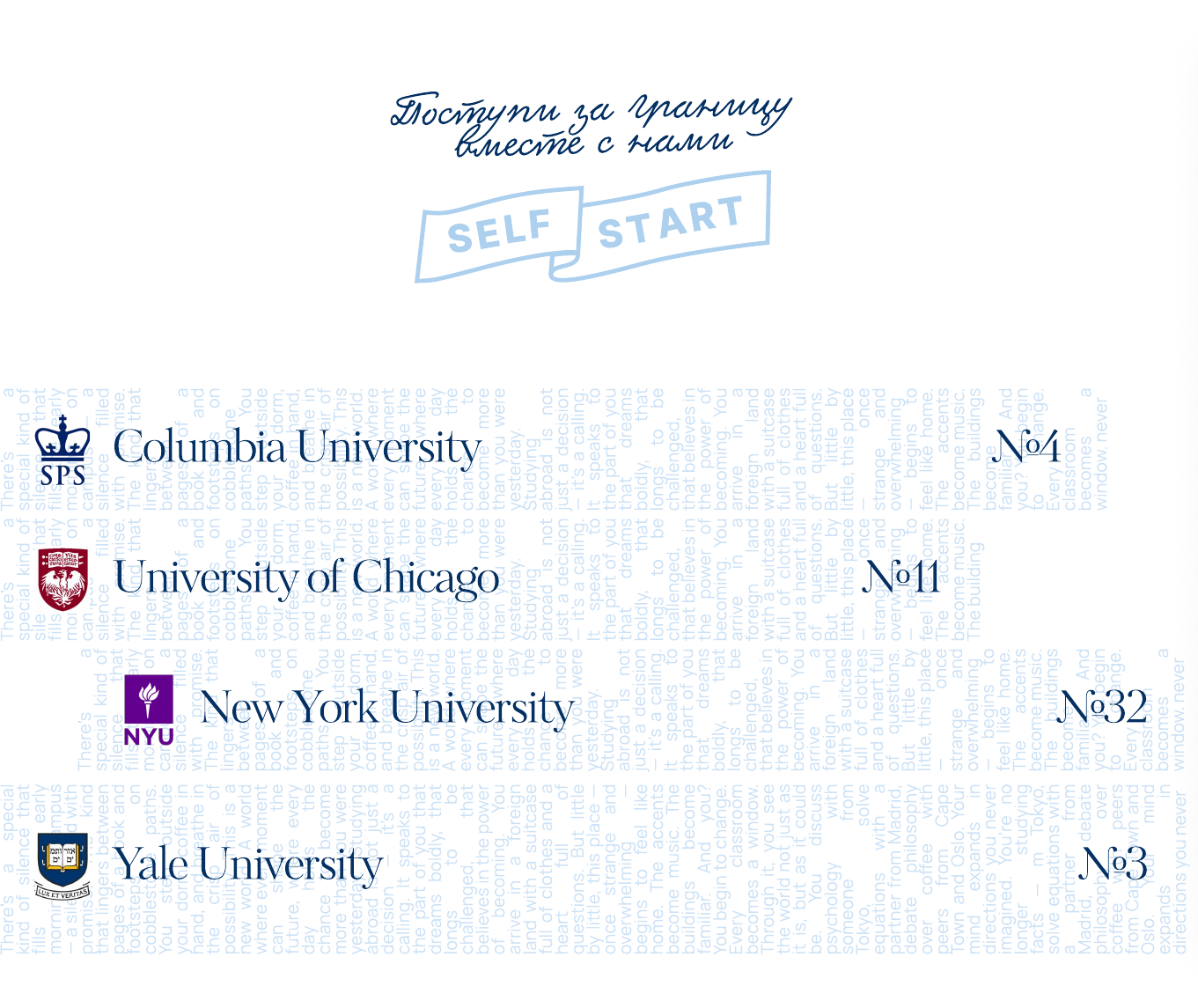
Leave your contacts — our consultant will get in touch
