




Service payment
Fill out the form and continue to payment via Stripe


Educational documents from Polish universities are recognized in all EU countries, opening up the labor market for graduates not only in Poland but also in Germany, the Netherlands, France, and other countries. Moreover, annual tuition here is 3-5 times lower than in the UK or Germany.
Another advantage is the linguistic environment. Polish is quite close to Russian, Ukrainian, and Belarusian, meaning adaptation is quicker than when moving to a country with a completely different language group. Furthermore, Poland is actively developing English-taught programs: today, over 500 undergraduate and graduate programs are taught entirely in English.
The Polish higher education system is fully integrated into the European educational space.
It is regulated by the Higher Education and Science Act (Ustawa Prawo o szkolnictwie wyższym i nauce) and is built according to the uniform standards of the Bologna Process, making Polish diplomas mutually recognized throughout the EU.
The Polish system includes three levels of study:
All programs use the ECTS credit system, ensuring compatibility with European universities and facilitating academic mobility.
Admission is possible as a full-time (stacjonarne) or part-time (niestacjonarne) student. Full-time studies at public universities are generally either free for Polish and EU citizens or charge reduced fees for foreigners, provided the student studies in Polish.
There are over 350 higher education institutions in Poland, of which approximately 130 are public. Public universities shape the academic prestige of Polish education and occupy the top positions in national and international rankings.
Public (publiczne) universities in Poland boast a high academic standard, developed research infrastructure, and significantly more competitive admissions processes. Tuition fees for foreigners are lower at these universities than at private ones, especially if the program is taught in Polish. Private (prywatne) universities offer more flexible admissions, less competition, and often a more modern educational process, but they tend to be more expensive.
The key difference: public universities are more strongly represented in international rankings, which is important for subsequent employment or an academic career in the EU. Private universities often offer superior service, multilingual support, and flexible scheduling — this is especially important for working students or those who do not enroll immediately after high school.
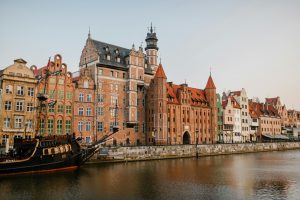 Tuition fees in Poland vary significantly depending on the type of university, the language of the program, and the chosen major. It’s important to understand this breakdown even at the selection stage— the difference between the minimum and maximum costs can be as much as 10 times.
This is the most affordable option for foreigners. At public universities, tuition starts at €1,100 per year for humanities and economics programs and reaches €1,800 for technical programs. Students with a Pole’s Card or a confirmed C1 level of Polish proficiency may be eligible for free tuition at public universities.
Admission to a Polish-language program requires proof of language proficiency: at least level B2. Starting in 2025-2026, the requirements have become more stringent: most universities require a B2 certificate as the minimum admission threshold for application review.
Achieving this level is realistic in a year and a half of intensive preparation, and a number of universities offer paid language preparatory courses (starting at USD 1,130 per year).
English-taught programs are more expensive but remain competitive in Europe. Their main advantage is that you don’t need to spend a year learning Polish; you can enroll immediately after high school or a bachelor’s degree. The cost ranges for 2026 are as follows:
By comparison, similar programs in Germany or the Netherlands start at €8,000-€12,000/year for non-EU citizens.
Beyond the basic tuition fee, actual costs are always higher than the advertised price. Many universities do not include a number of mandatory fees in their advertised fees, and it’s worth checking these in advance.
The following additional costs should be taken into account:
Living expenses often exceed the cost of tuition itself, especially in large cities. Proper budgeting before departure will help avoid unpleasant surprises in the first few months.
Accommodation is the main expense. The most affordable option is a place in a student dorm at a public university: from 390 to 920 zlotys per month (approximately 90-215 euros). In Wroclaw, dorm prices start at 500 zlotys, and in Poznań, from 620 zlotys for a place in a double room.
Renting a room in an apartment costs from 800 to 1,200 zlotys per month, while a full-size apartment starts at 1,400 zlotys, plus 200-250 zlotys for utilities. Warsaw is the most expensive city: a private room or a small studio can cost from 1,000 to 1,100 zlotys or more.
Important: you should move into the dorm well in advance, as places are booked up in July and August, and there may not be any available for September.
Everyday expenses in Poland are significantly lower than in Western Europe. Polish students actively take advantage of student discounts, which apply to public transportation (usually 50% off with a student ID card), museums, cinemas, and some stores. Average daily expenses:
The final figures depend on the city, type of housing, and lifestyle. Approximate ranges:
| Expense item | Economy (PLN/month) | Comfort (PLN/month) |
| Accommodation (dormitory/room) | 400-700 | 900-1 400 |
| Nutrition | 400-600 | 700-1 000 |
| Transportation | 50-80 | 80-120 |
| Communication and small expenses | 100-150 | 150-250 |
| Total | 950-1 530 | 1 830-2 770 |
This means that a student’s actual monthly budget ranges from €220 to €640 (excluding tuition), depending on the city and lifestyle.
The admissions process for foreigners at Polish universities differs from the system common in the CIS countries.
There is no single, centralized exam — each university reviews applications independently, so it’s important to research your specific university’s requirements in advance.
The standard application package for admission to a Polish university includes:
Important: translations must be certified by a Polish notary or a recognized translation agency — independent translations are not accepted.
A language certificate is a mandatory document; without it, your application will not be processed. Since 2025, the requirements have been officially tightened, so it’s important to check with the specific university in advance.
Without an official language certificate, the university is legally unable to process an applicant’s application.
Most programs operate on a competitive basis based on certificates —your grades on your high school certificate or university diploma are the primary selection criteria.
However, for some programs, this isn’t sufficient, and the university conducts additional selection.
Entrance exams are mandatory for:
Choosing a university by name alone is a mistake. The smart approach is to focus on the university group and specific program. A prestigious university with a mediocre program in your field is inferior to a lesser-known university with a strong, specialized department and good partnerships with employers.
Research/classical universities:
Technical and engineering:
Economics and Business Programs:
Medical:
The city where you live affects not only expenses but also the quality of student life, availability of internships, and the language environment. Choosing the right city is just as important as choosing a university.
| City | Cost of living | Internship market | Language environment |
| Warsaw | High | Excellent (corporations, startups) | A lot of English |
| Krakow | Average | Good (IT, tourism) | Polish, English in the center |
| Wroclaw | Average | Good (IT, logistics) | Polish, active international environment |
| Poznan | Average–low | Medium (industry, business) | Polish |
| Gdansk | Average | Medium (maritime industry, tourism) | Polish, English in the port area |
Warsaw is the best choice for careers in finance, law, and IT, but requires a larger budget. Krakow and Wroclaw offer the optimal balance between quality of life, cost, and internship opportunities for IT and business professionals.
Many applicants are unaware that international students in Poland have access to the same scholarship programs as Polish citizens, subject to certain conditions. This is a genuine means of reducing costs, not a formality.
International students have access to several types of scholarship support:
SelfStartGlobal is the only company on the market that prioritizes scholarship admission.
Working part-time while studying is a viable way to partially cover living expenses. However, in 2025–2026, the rules for international students changed, making it impossible to rely on work as a primary source of income.
From April to June 2025, new regulations came into force in Poland, significantly changing the employment situation for students. A student visa no longer allows direct conversion to a work permit: the transition from student status to the work category has become more complicated and requires separate justification.
However, working while studying is legally possible:
Regarding prospects after graduation, graduates in technical fields (IT, engineering) and medicine are in demand not only in Poland, but also in Germany, the Netherlands, and the Czech Republic. Polish diplomas are recognized in the EU, and a graduate with European experience and language skills is a competitive candidate on the EU labor market.
The bureaucratic process of moving to another country to study requires a significant amount of time and stress. Knowing the procedure in advance allows you to avoid queues, refusals, and forced delays in starting your studies.
For citizens of non-EU countries, the legalization process is as follows:
The key mistake is waiting until your visa “expires” and only then applying for a residence permit. You need to apply well in advance; the document confirming your application’s acceptance grants you the right to legally remain in the country during the processing period.
Most admissions problems aren’t accidental, but the result of common mistakes that recur year after year. Knowing these mistakes saves time, money, and stress.
Low tuition ≠ a good education. Some low-cost private universities lack accreditation for specific programs, making their degrees uncompetitive.
Notarized translations are only available from certified translators with an apostille; a standard translation will be rejected.
Many universities close their admissions process as early as May or June. Those who apply in August are left without dorm space, at a minimum, and at a maximum, without the desired program.
The certificate must be current (usually no more than two years old) and meet the requirements of the specific university.
When planning their budget, many students rely on tuition and forget that a deposit for a dorm or apartment adds another 1-2 months’ payment.
Starting in 2025, the employment situation for international students has become more stringent. A part-time job is a nice bonus, but it’s not the basis of a financial plan.

Leave your contacts — our consultant will get in touch
