




 How to choose the perfect university


She enrolled in Fashion PR programs at five US universities



Durham, North Carolina, USA · Duke University is one of the leading private research universities in the United States. It combines a strong engineering school, a world-class medical school, one of the country's top business schools, and a vibrant research environment. Admission to Duke University is challenging—the acceptance rate for the class of 2029 was a historically low 4.8%—but it's achievable if you approach it systematically and early.
Duke University was founded in 1838. The university’s current appearance was established in 1924, when tobacco magnate James B. Duke provided significant funding for the construction of a new campus. Today, Duke offers over 260 majors and programs, 15 departments and schools, and has one of the largest research facilities among private universities worldwide.
The university is part of the so—called Research Triangle, along with the University of North Carolina and NC State University, one of the largest technology and biotechnology clusters in the country. This gives students direct access to internships and research projects in real companies while still studying.
Notable Duke University alumni include Tim Cook (CEO of Apple), Melinda Gates (co—founder of the Gates Foundation), Nikki Haley (former U.S. Ambassador to the United Nations), and Grant Hill (NBA legend).
Bachelor’s degree: $73,172 per year (tuition $70,265 + mandatory fees $2,907, 2025-2026)
Master’s degree: from $3,882 per credit (Graduate School) – with a standard load of about $55,000-75,000 per year; Fuqua MBA – about $80,000 per year
Doctoral studies: PhD programs are in most cases fully funded through The Graduate School – tuition, insurance and a scholarship are covered for 5-6 years.
The full estimated Cost of Attendance (COA) for the bachelor’s degree in 2026-2027 exceeds $96,000 per year – taking into account accommodation (about $12,000-$18,000 depending on the type of room), food, insurance and personal expenses. Duke requires students to live on campus for the first three years, which makes it easier to plan expenses, but eliminates the opportunity to save money on off-campus housing until senior year.
Duke University unites 15 faculties and professional schools:
The Duke campus in Durham is one of the most recognizable in the United States. The Gothic architecture of the western campus, the Duke Chapel with its nearly 80-meter-high spire, and the extensive parkland and pine forests create an environment that is difficult to find in an urban university. At the same time, Durham is an active technology city, connected to Chapel Hill and Raleigh as part of the Research Triangle.
First-year undergraduate students are required to live on campus. Freshmen live on East Campus (historic Italianate buildings), and second-year students move to West Campus, near the main academic buildings, libraries, and laboratories. The dining and dining-hall system covers both campuses, and Duke consistently ranks among the top universities in the US for food quality.
Student life revolves around more than 400 organizations, from academic societies and entrepreneurial incubators to sports teams and cultural associations. The Duke Blue Devils basketball team is one of the most renowned in college sports, and games at the Cameron Indoor Stadium have become a staple of university culture. Duke competes in NCAA Division I athletics in 27 sports.
Admission to Duke University is a competitive process: the acceptance rate for the class of 2029 was 4.8% (58,611 applications, about 2,816 accepted). Applications are accepted through the Common App or the Coalition App.
Application deadlines. Early Decision: until November 1 (binding option). Regular Decision: until January 4.
Important: Duke follows a test-optional policy, where high SAT/ACT scores enhance the application, but their absence is not a barrier.
Choose your level of study and school: bachelor’s degree at Trinity College of Arts & Sciences or Pratt School of Engineering; master’s degree and professional programs at Fuqua, Duke Law, School of Medicine, Nicholas School, and others.
The university evaluates the average score and the difficulty of the program. AP, IB, or similar advanced-level courses are a significant advantage for applicants.
In addition to the Common App essay, Duke asks its own additional questions, one of which traditionally asks why Duke and how you plan to use its resources. The admissions committee is looking for specifics rather than formulaic answers.
Two letters from school teachers in specialized subjects and one from the class teacher or principal.
Duke particularly values leadership positions, academic achievements, and social engagement. The depth of involvement is more important than the length of the list.

For international applicants, the standard application package includes academic transcripts translated into English, essays, letters of recommendation, and language test scores such as TOEFL (recommended score of 100+ iBT) or IELTS (recommended score of 7.0+).
It is important for international students to note that Duke only applies need-blind admission for U.S. citizens, permanent residents, and undocumented students. For foreign citizens, the need-aware admission process takes into account the family’s financial situation during the selection process, and international applicants who request financial assistance are considered in a more competitive pool (the acceptance rate for this group is typically less than half of the overall rate). Additionally, all accepted international students who have declared a need for assistance receive 100% coverage of their confirmed financial need.
It is crucial to note that financial assistance must be requested during the initial application process by selecting the appropriate option in the application form. International students who do not do this upon admission are not eligible for need-based aid for the entire duration of their undergraduate program.
Duke University covers 100% of the confirmed financial need of each admitted undergraduate student, both for U.S. citizens and for international students who have been admitted with a request for aid.
PhD students through The Graduate School receive full funding for 5 years, including tuition, insurance, and a stipend.
The Duke Knight-Hennessy Scholars is a prestigious program for master’s and PhD students that offers full funding, a living stipend, and access to a global network of leaders.
The median salary for Duke graduates six years after graduation is $85,792 per year (US News). More than 90% of graduates are employed or continuing their education within six months of graduation.
The Duke Alumni Association has over 175,000 alumni in 170 countries, an active professional community with real career opportunities. Proximity to the Research Triangle gives you direct access to technology, biotechnology, finance, and consulting companies — students get access to internships while still in school.
Fuqua School of Business provides a strong connection to top employers in consulting, finance, and technology — McKinsey, Goldman Sachs, Google, and Amazon are consistently on the list of companies recruiting Duke graduates.
Duke has more than 70 research centers and institutes, including the Duke Human Vaccine Institute, the Nicholas Institute for Energy, Environment & Sustainability, and the Duke Center for International Development. The university consistently ranks among the top private universities in the United States in terms of external research funding, attracting over $1.5 billion in research funding each year.
Undergraduate students can participate in real-world research from their first year through the Bass Connections program, which brings together students, faculty, and professionals from various disciplines to work on practical challenges in the fields of medicine, policy, technology, and the environment.
Duke School of Medicine is one of the country’s leading medical research centers. Duke University Health System is one of the largest academic medical centers in the Southeastern United States. The university is also a pioneer in the fields of genetics and genomics, having developed some of the first genetic mapping techniques in the 1980s, which laid the foundation for the Human Genome Project.
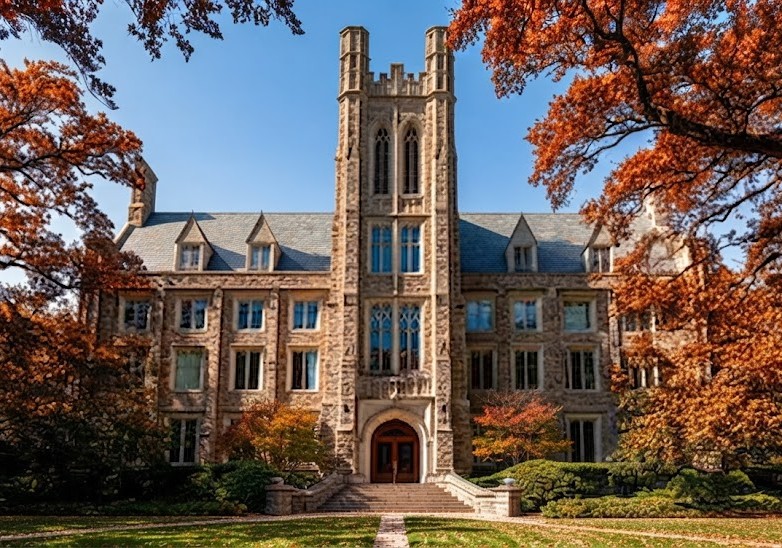
Duke received its current name in 1924, in honor of James B. Duke, after the university was previously known as Trinity College.
Duke’s student-to-faculty ratio is 5:1, one of the best among major research universities in the United States.
The campus covers 8,693 acres, one of the largest in the United States, with a large portion dedicated to protected natural areas, including the 7,000-acre Duke Forest.
The Duke Chapel was built in 1932 and is now one of the most photographed buildings at American universities.
Duke Kunshan University in China is one of the first true dual-campus American universities with full-fledged academic programs in both fields.
Duke alumni include three U.S. presidents (based on their years of study in diplomacy and public administration) and more than 50 recipients of various national and international awards.
Admission to Duke University requires not just a strong transcript, but a well-thought-out strategy at every stage. We at SelfStartGlobal help:
Our students have already received scholarships worth more than $35 million.
If you want to apply to Duke University and receive maximum financial support, come for a free consultation. We will tell you how it works in your specific case.

She enrolled in Fashion PR programs at five US universities

She was admitted to three American universities at once: Augustana College, Widener University, and the University of South Dakota. She chose Augustana College, where she received a scholarship of $45,000 per year.

He entered a master’s program in the USA at two universities at once – Brandeis University and Washington University in St. Louis, receiving scholarships totaling $80,000. He chose Brandeis University and went to study on the first try.
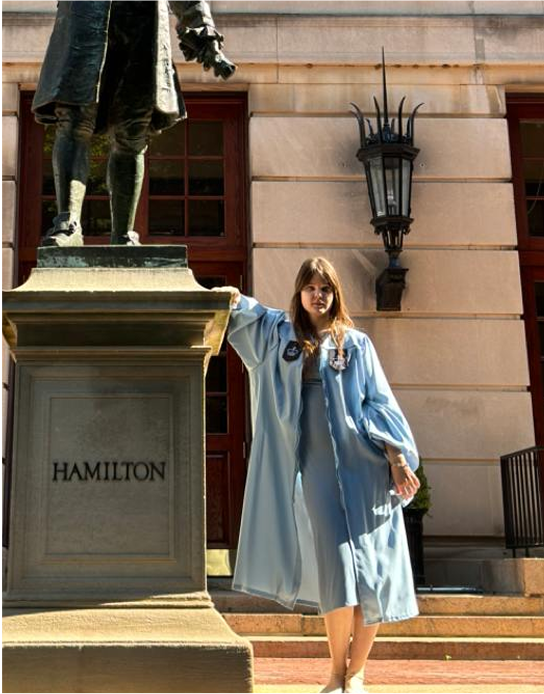
I was accepted to the PhD program at Columbia University on my first try, having strengthened my profile and compiled my achievements into a strong application.
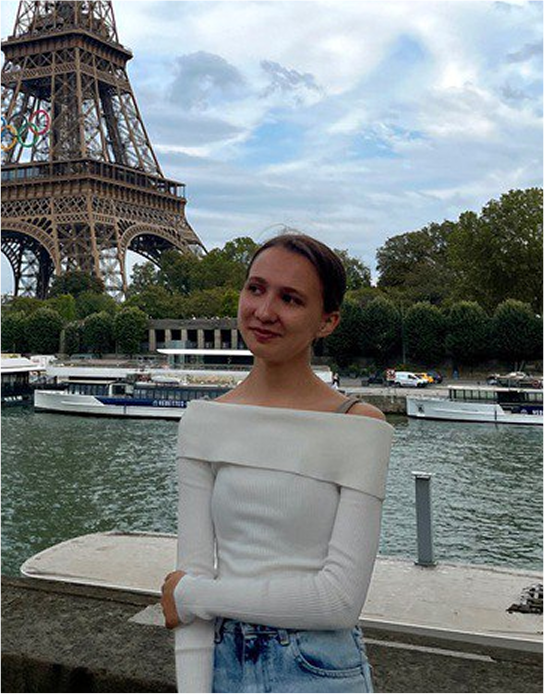
She enrolled in graphic design at universities in France, Italy and Hungary. She received scholarships at all of them and chose the university with the maximum funding — $135,000 for the entire period of study.

She entered graduate school at Kent State University and Ohio University. At Ohio University, she won a Graduate Teaching Assistantship with full funding of $37,774, covering tuition, insurance, and living expenses.

He entered Siena Heights University (USA) for the Theater and Music program with a full scholarship of $170,000. Preparation took less than a year.

Got accepted to NYU Abu Dhabi on the first try (acceptance rate 4%) with a scholarship of $217,000. Also received offers from Lynn and Drexel University.
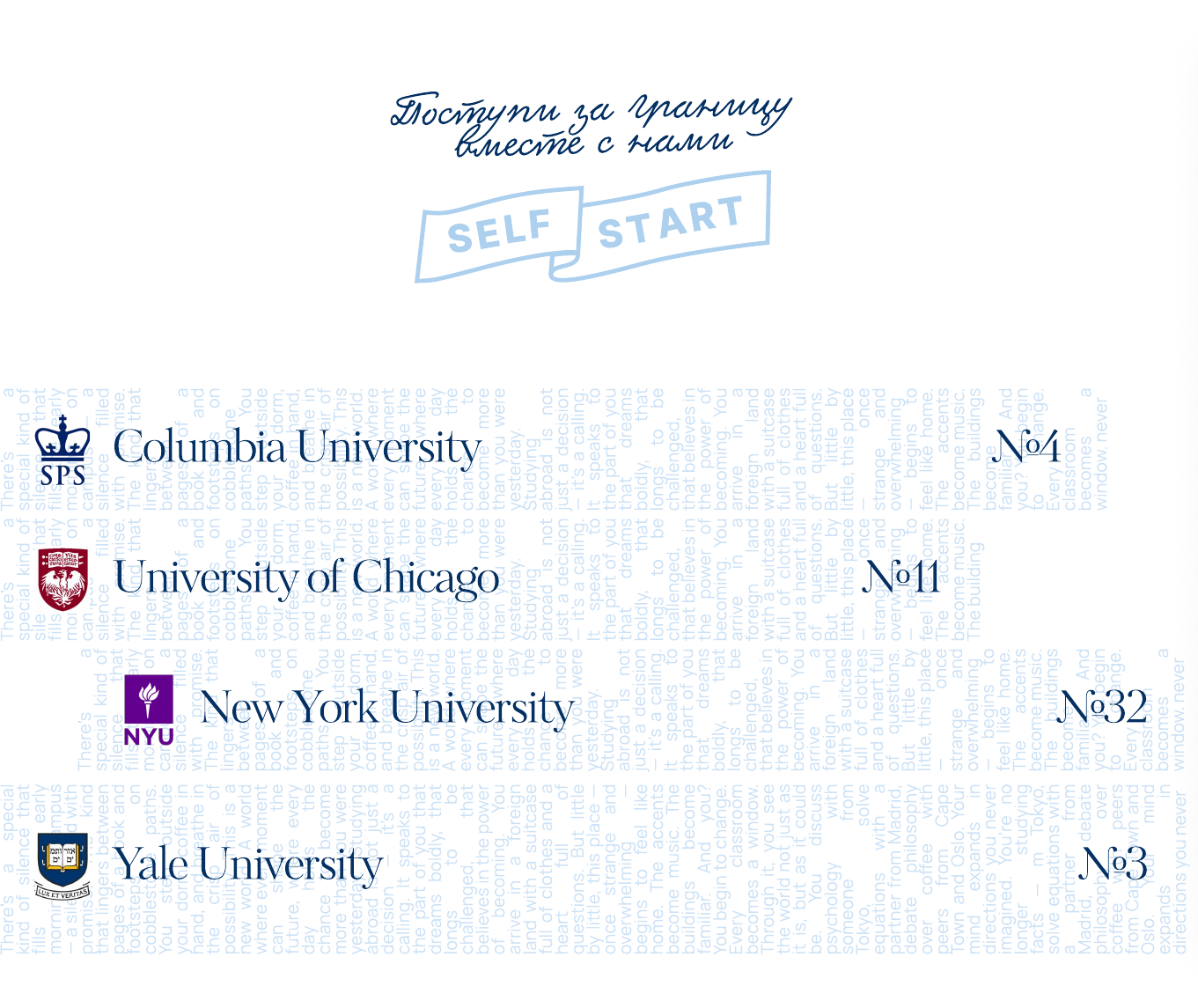
Leave your contacts — our consultant will get in touch
