





 Study Abroad: How to Apply and What to Expect After Graduation


Service payment
Fill out the form and continue to payment via Stripe
Italy, Padua · The University of Padua (Università degli Studi di Padova) is a public research university in Padua founded in 1222, ranking among the oldest universities in Europe. In this article, we explain which programmes are open to international applicants, which academic level and application track best fit your profile, and how to begin preparing your application. Discuss your optimal admissions route with a SelfStartGlobal advisor.
Università degli Studi di Padova, founded in 1222, ranks among the oldest universities in Europe. Located in Padua (Veneto, northern Italy), the university offers academic programmes taught in both Italian and English. Historically, it has held strong academic reputations in medicine, law, and the natural and exact sciences. Education is structured according to the Bologna system across three levels: bachelor’s, master’s, and doctorate degrees.
The University of Padua (UNIPD) comprises 32 departments grouped into major academic schools. Below are the key subdivisions along with their available degree levels and languages of instruction. The full catalogue of programmes and specific entry requirements are available at unipd.it/en/educational-offer.
Covers bachelor’s (Laurea triennale), master’s (Laurea magistrale), single-cycle (Ciclo unico), and doctoral (PhD) programmes. Instruction is primarily in Italian, while the dedicated Medicine and Surgery degree (Medicine in English) is taught entirely in English.
Offers Laurea triennale, Laurea magistrale, and PhD programmes in the natural and exact sciences. The main language of instruction is Italian, with a significant share of master’s programmes taught in English.
Trains students at the bachelor’s (Laurea triennale) and master’s (Laurea magistrale) levels. Courses are taught in Italian, with several programmes—primarily at the master’s level—offered in English.
Brings together bachelor’s (Laurea triennale) and master’s (Laurea magistrale) programmes in economics, management, and political science. Instruction is mainly in Italian, with a selection of courses taught in English.
Offers five-year single-cycle programmes (Laurea magistrale a ciclo unico) in legal studies. Teaching is conducted in Italian.
Encompasses bachelor’s (Laurea triennale) and master’s (Laurea magistrale) programmes in psychology, education, and the humanities. The primary language of instruction is Italian, with selected programmes available in English.
Campuses and Dormitories
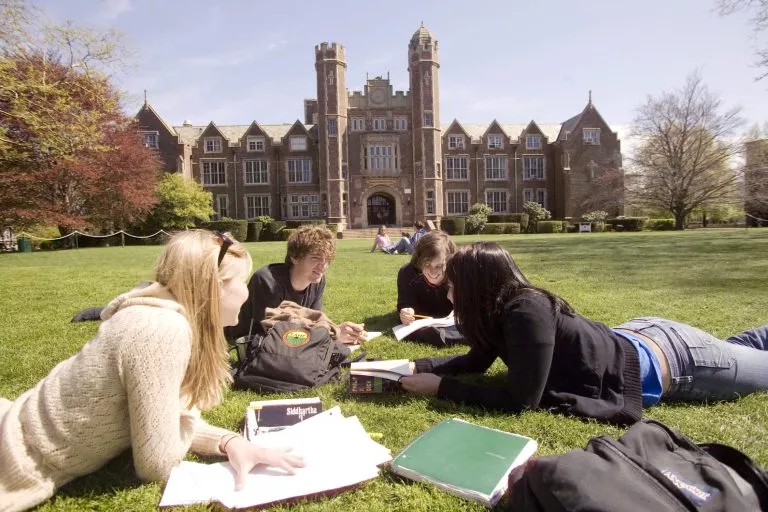
The campus of the University combines modern buildings and historical structures, creating a unique atmosphere for studying and living. The University of Padova is surrounded by cafes, shops and cultural centers, making it an important part of the student community.
Academic buildings and departments are spread across the historic centre of Padua rather than concentrated on a single enclosed campus. Students reside in the city or surrounding districts. Applications for student residence halls are submitted separately through the regional accommodation provider, ESU di Padova; however, due to limited capacity, a place is not guaranteed.
On the private market, average room rentals in Padua range from €350 to €600 per month depending on the neighbourhood and apartment condition. Lease agreements are arranged directly with the landlord.
A valid student ID card grants access to university libraries, research laboratories, study spaces, and the career centre. The full list of facilities and services available to students is published on the respective department's webpage.
The faculties have modern laboratories and research centres for conducting cutting-edge research.
The university offers sports halls and grounds for fitness and participation in sports events.
Required documents and entrance exams depend on the specific programme and its respective call. When applying for English-taught degrees via apply.unipd.it, a non-refundable application fee of €60 applies, whereas programmes requiring the CEnT-S entrance test carry a €55 fee. Generic IELTS or TOEFL score thresholds apply only when explicitly stated in the individual course requirements.
When evaluating your profile, keep in mind that the official minimum score, the recommended score, and the average profile of admitted students are three distinct benchmarks.
Applicants must submit an official transcript of records alongside their degree diploma or secondary school certificate (an enrolment certificate is accepted at the application stage). These records are obtained from your current or previous institution and uploaded by the applicant to apply.unipd.it.
Provided by the applicant if proof of English proficiency and a minimum score are required by the selected course. The list of accepted certificates and required scores is published on the individual programme page.
The applicant prepares an academic CV and a motivation letter in English and uploads both documents directly to their application profile on apply.unipd.it.
To verify identity, the applicant uploads a copy of a valid passport or national ID card to the apply.unipd.it portal.
In addition to standard application materials, applicants must complete pre-enrolment on the Universitaly portal and sit the IMAT entrance examination. Detailed admission rules are available at unipd.it/en/medicine.
For programmes taught in Italian, applicants must demonstrate language proficiency at the level specified by the faculty. Exact requirements regarding accepted certificates or language tests are listed on the programme page.

Identify the exact title, degree level, and language of instruction in the catalogue at unipd.it/en/educational-offer. Check whether the programme operates on an unlimited-place or limited-place admission track. At this stage, the applicant and a SelfStartGlobal advisor work together to define the optimal admissions strategy.

Compare your educational credentials against the programme's academic entry criteria, verify language proficiency requirements, and check whether an entrance test (such as CEnT-S) applies.

Collect your academic transcript with a certified translation, an English CV and motivation letter, a copy of your passport, and a language certificate (if required by the course). The applicant always reviews and approves the final text of the motivation letter.

Create an account on apply.unipd.it, fill out the online application form (Appform), and upload your complete document package. Pay the non-refundable application fee of €60 (or €55 for programmes requiring the CEnT-S test). Applications submitted after the call closes are not accepted.

Monitor your application status in your personal dashboard on apply.unipd.it. Once you receive an offer of admission, proceed with formal university enrolment and student visa preparation.
Each UNIPD programme publishes its own call for applications. The reference dates below reflect confirmed timelines for 2026/27 English-taught programmes in Central European Time (CET). As the 2027/28 academic calendar has not yet been published, always verify the exact dates on apply.unipd.it before submitting your application.
English-taught, Unlimited-place (Non-EU Residing Abroad) — Call 1
Applications are accepted via apply.unipd.it from 15 September to 15 November 2026 (CET).
English-taught, Unlimited-place (Non-EU Residing Abroad) — Call 2
The second intake window on apply.unipd.it runs from 1 December 2026 to 1 March 2027 (CET).
English-taught, Limited-place (Non-EU Residing Abroad) — Call 1
Applications for competitive limited-place programmes are open via apply.unipd.it from 7 January to 7 March 2027 (CET).
Medicine and Surgery (IMAT) — Separate Call
Follows a separate admissions schedule, typically around June–July (CET). Exact dates and registration rules are published at unipd.it/en/medicine.
Pre-enrolment on the Universitaly portal at the application stage is required solely for Medicine and Surgery and must be completed separately from the competitive application.
Tuition depends on the student’s residency and fee category. For international students without an Italian residence permit (non-EU residing abroad), UNIPD applies a flat rate introduced in the 2023/24 academic year. Students resident in Italy pay on a sliding ISEE scale ranging from €0 to approximately €3,000 per year. SelfStartGlobal advisory services are charged separately.
Before enrolment, always verify the exact figures for your academic year at unipd.it/en/tuition-fees.

The University of Padova offers various scholarships and grants for international students, aimed at supporting their studies and adaptation at the university. The scholarships are intended for both local and international students.
Awarded for outstanding academic achievement and potential. To be awarded, students must demonstrate high results in entrance exams, outstanding grades, and participate in scientific or educational projects.
The University of Padua offers scholarships to international students, especially from low-income countries, to support their studies and integration into the academic environment.
Awarded to students working on research projects as part of their master’s or doctoral programs, these scholarships help cover the costs of research and conference participation.
The University of Padua operates a dedicated career centre (Job Placement) that supports students and graduates in finding internships and entry-level positions. However, it serves as a guidance resource rather than a guarantee of employment. Access to specific internships depends on your degree programme’s structure, individual employer criteria, and your language proficiency.
The right to work during your studies and remain in Italy after graduation is governed by national immigration law; always verify current regulations and residence permit conditions on the official website of the Italian Ministry of the Interior.
The University of Padua collaborates closely with European and international employers, connecting students with practical training and career pathways across diverse sectors. Its partner network spans technology and financial companies, scientific research institutes, medical centres, and major international organizations, including UN agencies and the World Health Organization (WHO). Through these institutional links, students can gain relevant international experience and build a professional foundation during and after their studies.
The University of Padua supports students in securing internships and work placements through its dedicated career centres and active alumni network. Depending on their academic field and career goals, students can explore both paid and unpaid internship opportunities across a wide range of industries and sectors.
Maastricht University actively supports graduates in their professional development through dedicated career services and global connections. The Alumni Association helps graduates expand their professional networks, while university career counsellors offer individualized guidance and coaching. In addition, digital resources—including career webinars and virtual recruitment fairs—provide ongoing access to current job openings and industry insights.
The University of Padua is one of Europe’s oldest research centres and a key contributor to the development of modern science. It pioneered revolutionary approaches to anatomy, botany and astronomy, and provided the freedom of thought that enabled great scientists from Vesalius to Galileo to make discoveries that changed the world.
Andreas Vesalius conducted the first systematic anatomical studies, refuting ancient ideas about the structure of the human body.
In 1595, the world's first permanent theatre for public dissections opened in Padua, a model followed by universities throughout Europe.
Founded in 1545, the Orto Botanico of Padova is considered the oldest university botanical garden and is today a living laboratory and a UNESCO site.
William Harvey, who described blood circulation, worked closely at the university, and later Milla Baldo Ceolin made significant contributions to particle physics and neutrino research.
SelfStartGlobal supports applicants through the key stages of preparation and the application process:
We identify the most suitable program, academic level, and intake period (call) based on your background and educational credentials.
We create a schedule of deadlines for your chosen programs, entrance exams, and the procurement of letters of recommendation.
We cross-reference your diploma or school-leaving certificate with the academic requirements listed on unipd.it and provide a detailed breakdown of the checklist found on the apply.unipd.it platform.
We review and provide comments on drafts of your motivation letter and CV; the final versions of these documents are always subject to your approval.
We verify that your application is complete before you submit it via your personal account and assist you in monitoring its status thereafter.
Yes, admission is possible, but the specific admission requirements depend on the chosen program and its requirements for foreign educational documents (including the need for 12 years of schooling or completion of a preparatory year). Be sure to check the academic criteria on the page of the chosen course and in the unipd.it/en/how-apply section before registering in the system.
There is no single threshold score for the entire university. For English-language programs (English-taught), a language certificate is required only if it is explicitly stated in the terms of a particular course. For Italian-taught programs, it is necessary to confirm proficiency in Italian at the level set by the faculty.
Foreign applicants submit their documents online via the apply.unipd.it platform. The deadline depends on the type of program and the recruitment flow (call): for example, for unlimited-place programs, Call 1 is open until November 15, 2026, and for limited-place programs, Call 1 is open until March 7, 2027. Applications submitted after the admission window closes are not considered.
For international students without a residence permit in Italy (non-EU residing abroad), the tuition fee is €2,790 – 2,990 per year (a preferential rate is provided for citizens of the least developed countries). Additional living expenses are also included: room rental (€350–600 per month), food and daily necessities (€400–600 per month), health insurance (€200–400 per year), the first registration fee upon enrollment (€208), and a non‑refundable application fee (€60).
The SelfStartGlobal consultant helps determine the educational path, creates a personal deadline calendar, checks whether the documents meet the university’s requirements, and provides detailed feedback on drafts. The candidate themselves is responsible for the final text of the motivation letter, requesting recommendations, registering in the system, and paying the fees.
The material has been verified using official sources (October–November 2026):
S1 Admission with foreign qualifications — unipd.it/en/how-apply
S2 Tuition fees and categories — unipd.it/en/tuition-fees
S3 Official programmes — unipd.it/en/educational-offer
S4 Application Portal — apply.unipd.it
S5 How to apply guide 2026/27 — web.unipd.it (PDF)
Add the review date and editor’s name after confirmation by the team. Re‑check the data on deadlines and rates before publication.
Leave your contacts — our consultant will get in touch
