


Which US universities can you enter without the SAT and ACT?

Is it possible to get into a US university without the SAT and ACT?

The SAT and ACT used to be mandatory. That’s changed. Now, it’s possible to get into the Ivy League or top public universities in the US without the SAT!
Universities’ approach to assessing applicants has changed. Admissions committees understand that a short exam doesn’t reveal a person’s full talents. Universities have begun setting their own requirements: completely waiving test scores or submitting scores voluntarily.

You can apply to a prestigious university without test scores. The university will then carefully review your remaining documents. To decide whether to waive the exam, evaluate your high school grades and the quality of your portfolio in advance. Currently, admissions policies in the US vary, from completely waiving test scores to voluntarily submitting them.

What are test-optional, test-blind, and test-flexible?

To effectively develop a strategy, it’s important to clearly distinguish between three key terms that define university testing policies.

Test-optional

This is the most popular category. Test-optional US universities allow applicants to choose whether to submit SAT or ACT scores. If you’re satisfied with your test score, it should be included with your application. If your score is low or you’ve decided not to take the exam at all, you can submit your application without it. The university undertakes not to penalize you for missing scores and will consider your application equally with others.

Test-blind

This policy is even more radical. At test-blind US universities, admissions committees categorically do not consider standardized test scores, even if you submit them. Your scores will not be visible to the decision-making officer. This equalizes the applicants’ chances.

Test-flexible

In some cases, universities are flexible. This means they may accept other metrics instead of the SAT/ACT. For example, AP (Advanced Placement) exam results, IB (International Baccalaureate) results, or high scores on national final exams in your country.

What types of US universities can you apply to without the SAT and ACT?

Liberal Arts Colleges

Liberal arts colleges often implement progressive admissions systems. They prioritize the student’s personality and contribution to the community. US colleges in this category, which do not require the SAT or ACT, emphasize essays and interviews.

Private Universities with Flexible Policies

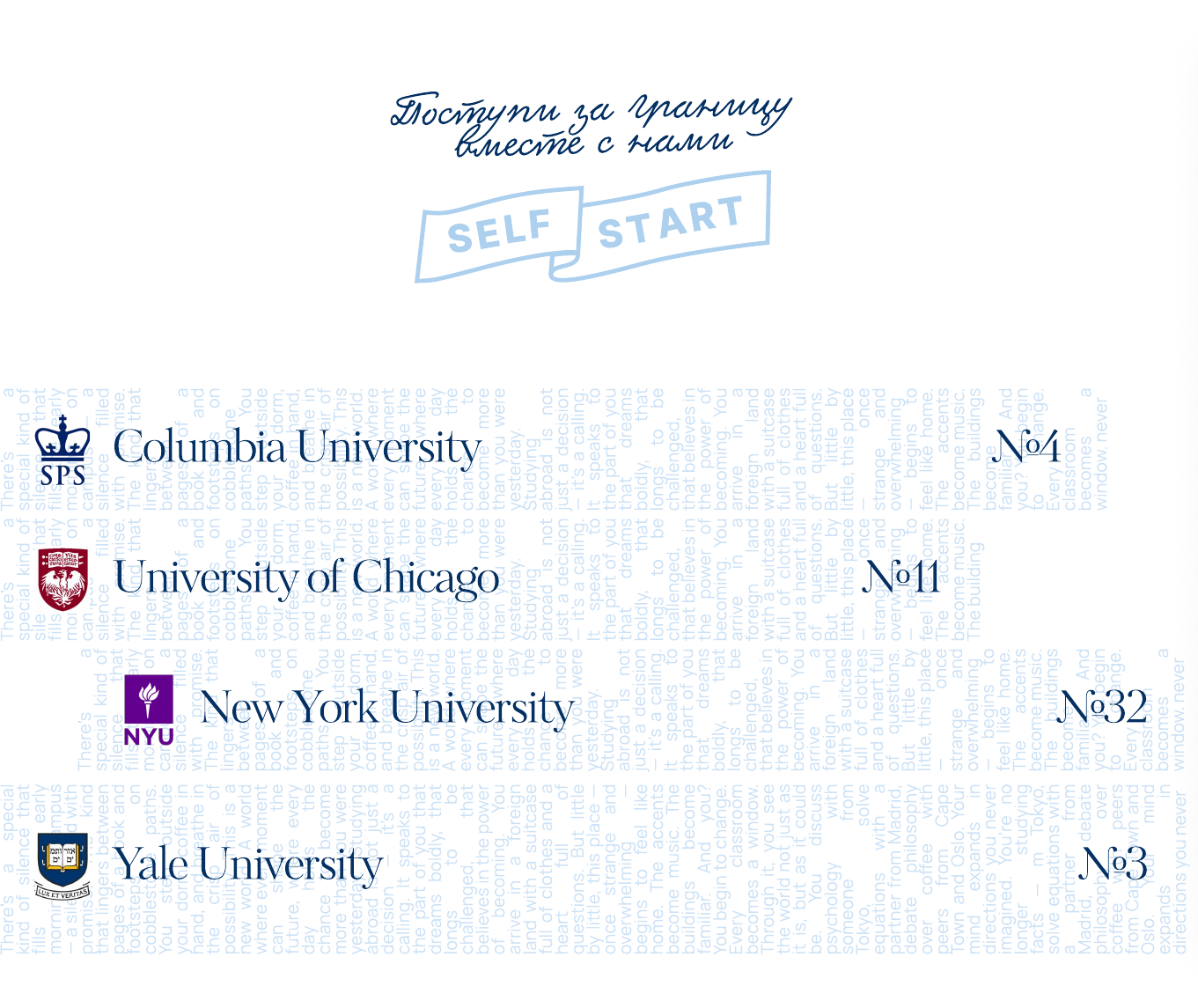
Large private universities, such as the University of Chicago or NYU, have flexible policies. They want to attract talented students from different countries. They understand that international applicants often struggle to find resources to prepare for exams. Eliminating tests helps applicants gain admission on equal terms with others.

Public Universities

The rules here vary greatly. For example, the University of California (UC) system has switched to a test-blind policy. Universities in Florida and Georgia may still require tests. Check the current requirements for your specific campus.

Community Colleges

Admission to community colleges in the US without the ACT or SAT is standard practice. Tests are not required, and after two years of study, students can transfer to a prestigious four-year university with American grades, not just high school test scores.

Who is the SAT/ACT-free admission strategy really for?

It’s important to understand: waiving tests is a strategic decision. This strategy is ideal for:

  • Students with a very high grade point average (GPA).
  • Applicants with a unique extracurricular profile.
  • Those who experience significant exam stress—if your knowledge is objectively superior to what you demonstrate under tight test timing.

In such cases, applying to the US without standardized tests is justified: you don’t waste time studying for the test, but focus on the quality of your essays and projects.

When is it better to take the SAT or ACT?

Despite the universities’ leniency, a high SAT score remains a powerful tool. You should take the test if:

  1. Your GPA is lower than desired and you need to prove your academic worth.
  2. You are applying for scholarships in the US without the SAT or ACT at universities where merit-based aid is tied to academic achievement.
  3. You are attending a school with an unknown or poor reputation. A high SAT score will confirm your grades on your transcript.

What becomes especially important in an application without the SAT and ACT

When test scores are removed from the equation, the weight of the remaining components increases. To understand how to strengthen your application without the SAT, consider the following:

Academic performance Плюсик

GPA is becoming the primary indicator. The admissions committee will look not only at your overall score but also at the difficulty of your chosen courses. If you took challenging courses and mastered them, this is your best argument.

Extracurricular activities Плюсик

Extracurricular activities should be active. Club leadership, volunteering, personal projects, and winning competitions—all of this should demonstrate that you’re a part of society.

Essay Плюсик

The Personal Statement and supplementary questions are your voice. Without tests, your essay must be flawless. This is your chance to tell your story and explain why you’re a good fit for this university.

Recommendations Плюсик

Teacher reviews provide important information to the admissions committee. Universities want to know how you conduct yourself in the classroom, whether you think critically, and whether you work in a team.

Is it possible to get a scholarship without the SAT and ACT?

The stereotype that tests are required to qualify for funding is a myth. You can receive financial aid even without the SAT and ACT.

  • Need-based aid: Need-based aid is not dependent on test scores at all. Universities like Harvard award funds based on your family’s income.
  • Merit-based scholarships: Merit-based scholarships may require you to provide scores. However, more and more universities are considering them as optional.

How to Choose US Universities If You Don't Take the SAT and ACT

When compiling your list of universities, follow this algorithm:

  • Check the rules. Make sure the university doesn’t require tests for international students. Rules for domestic and international students vary.
  • Analyze the statistics. Find out how many admitted students submitted applications without scores (the university’s Common Data Set). If 80% of admitted students submitted scores, it might be worth looking for a more flexible institution.
  • Evaluate grants and funding. Look for universities that openly state that the lack of test-taking doesn’t affect grant distribution.

Mistakes Applicants Make When Applying Without the SAT and ACT

Test-optional admissions (TAOs) are often mistakenly considered an easy path to college admissions in the USA. In reality, this approach requires significant preparation. Let’s look at the main mistakes applicants make:

Expecting simple requirements. Without SAT scores, universities evaluate your school grades and essays more strictly. The requirements for the quality of your documents only increase.

Outdated information. Admissions policies may change annually. It is important to check the current requirements on the university website before each application.

A weak portfolio. If you don’t have exam results, you must stand out through other achievements. Your application must demonstrate a unique talent or leadership qualities.

How to Improve Your Chances of Admission to the US Without Standardized Tests

Here’s a checklist for strengthening your application without using tests:

  • Start early. Begin preparing your documents and portfolio at least eighteen months to two years before admission.
  • Develop a project. Focus on one unique achievement or hobby that will set you apart from others.
  • Work on your essay. Carefully review every sentence in your texts to ensure they fully reveal your personality.
  • Balance your list. Choose universities of varying levels that value personal qualities, not just numbers.

Who can benefit from the Community College and Transfer pathway?

If you’re unsure of your English or academic skills, two-year US colleges without SAT and ACT scores are an ideal starting point. They’re cheaper and easier to apply for, and offer the opportunity to transfer to a top university after two years. SAT scores are not required for the transfer system, as success at the college itself is more important.

Want to know which US universities are best for you to apply to without the SAT or ACT?

Applying to America is a complex process where every step requires careful consideration. If you’re unsure whether the SAT is necessary for admission to the US or how to create a competitive list of universities without unnecessary exams, we can help:

  • Assess your current profile (GPA and activity level).
  • Choose a list of universities with a test-optional policy that works in your favor.
  • Develop a scholarship strategy without the SAT/ACT.
  • Create outstanding essays that will set you apart from thousands of applicants.

Schedule a consultation today to build your personalized path to an American degree!
Universities

Paduana


University

Italy
One of the oldest universities in Europe with strong traditions in science, medicine, and the humanities. Attractive due to its combination of academic quality, affordable tuition, and student life in Italy
Bachelor's degree: from €2,000 to €4,500 per yearMaster's degree: from 3,000€ to 6,000€ per yearDoctoral studies: from 1,500 to 3,000 € per year
Maastricht University
Netherlands
A modern university in the Netherlands, known for its innovative Problem-Based Learning (PBL) approach. Popular among international students, especially in business, economics, law, and healthcare
Bachelor's degree: from €9,000 to €15,000 per yearMaster's degree: from €10,000 to €18,000 per yearDoctorate: free or about €2,500 per year
University of Florida
USA
A large public research university in the United States with a high academic ranking. Offers a wide range of programs, strong STEM fields, and more affordable tuition compared to private universities
Bachelor's degree: from $55,000 per yearMaster's degree: $15,000 - $40,000 per yearDoctoral studies: $10,000-$30,000 per year
Johns Hopkins University
USA
A leading U.S. research university and a global leader in medicine, biotechnology, and international relations. Distinguished by a strong focus on research, practice, and interdisciplinary studies
Bachelor's degree: $63,340 per yearMaster's degree: $65,956 per yearDoctoral studies: about $65,000 per year
Princeton University
USA
One of the most prestigious universities in the United States, part of the Ivy League. Strong in natural sciences, engineering, economics, and the humanities. Known for a high level of academic support and generous scholarships
Bachelor's degree: about $60,000 per yearMaster's degree: average $58,000 per yearDoctoral studies: free*
Подобрать университет

Countries

USA
A US education offers prestige and limitless opportunities. American degrees are highly valued worldwide, and graduates from leading universities are eagerly sought after by international companies. US universities consistently occupy top positions in global rankings. Studying here opens the door to a global career and a unique student experience.
Read more ➜
Выбрать страну

Our services

MentoringA personal mentor at every stage of preparation. A clear plan, oversight of every step, and predictable results.
Full supportA turnkey international application process: a customized strategy, document preparation, and visa support—all in one service, guaranteeing you admission to a university abroad.
Personal brand in a yearIn 12 months, we'll build your strong personal brand for international study: we'll formulate a strategy, select activities, and identify achievements that will increase your chances of admission and scholarship awards.
Selection of activities for Personal brandA personal brand is the foundation for applying for a scholarship. Get a list of activities that will enhance your profile and distinguish you from other applicants.
Universal supportAccelerated preparation for admission: save money and time without compromising results.
Consultation with an expertAn in-depth 60-minute consultation: we'll discuss your admissions chances, financing options, develop a personalized strategy, and answer all your questions.
Consultation with a career guidance specialistWe'll help you identify your strengths and inclinations, choose the right field of study, and build a successful career.
Getting a student visa from the USAWe'll help you obtain a student visa without stress or errors, and we'll also assist you if your application is rejected.
Selection of universities and scholarshipsWe'll create a list of universities and programs that are right for you—with a realistic chance of admission and scholarships.
Admission to Foundation Programme AbroadWe'll help you enroll in the Foundation Program, a program that allows you to transfer to a bachelor's degree abroad without losing a year. We'll select suitable options, prepare your documents, and develop a strategy.
Preparation of documentationStrong documents make a strong candidate. We'll help you prepare your application package based on both formal and informal university requirements.

Related articles

Study Abroad: How to Apply and What to Expect After GraduationМечтаешь учиться за границей, но в голове множество вопросов и сомнений? Разбираем, как поступить в иностранный вуз, с чем предстоит столкнуться во время учебы и что ждет после.
Время чтения:
0 мин
Top 7 Universities in the World: How to Enter a Prestigious UniversityТоповые университеты мира — мечта или переоцененный миф? Рассказываем, как поступить в престижный вуз, что на самом деле дают громкие имена, и стоит ли гнаться за рейтингами любой ценой.
Время чтения:
0 мин
What documents are needed to study abroad and how to prepare themМечта об учебе за границей может разбиться о бумажную волокиту — если не знать "правила игры". В статье разбираем, какие документы действительно нужны, и на что обращают внимание приемные комиссии зарубежных вузов.
Время чтения:
0 мин
TOEFL or IELTS: which one to choose for studying abroad?We compare the TOEFL and IELTS exams to help students choose which test is best suited for studying abroad. We examine the key differences in format, scoring system, and international recognition of the exams.
Время чтения:
0 мин
How can I stay and work abroad after completing my studies?How to stay and work abroad after graduation: visa options and pathways, as well as practical steps to start a career overseas.
Время чтения:
0 мин
How much does it cost to study abroad in 2026?Studying abroad in 2026 involves various costs, from tuition fees to living expenses. Understanding these costs helps students plan their budget more effectively.
Время чтения:
0 мин
Education abroad: popular countries 2026Find out the most in-demand countries to study abroad in 2026. We look at the benefits, programs and opportunities that attract students from all over the world.
Время чтения:
0 мин